Tuesday, July 21, 2015

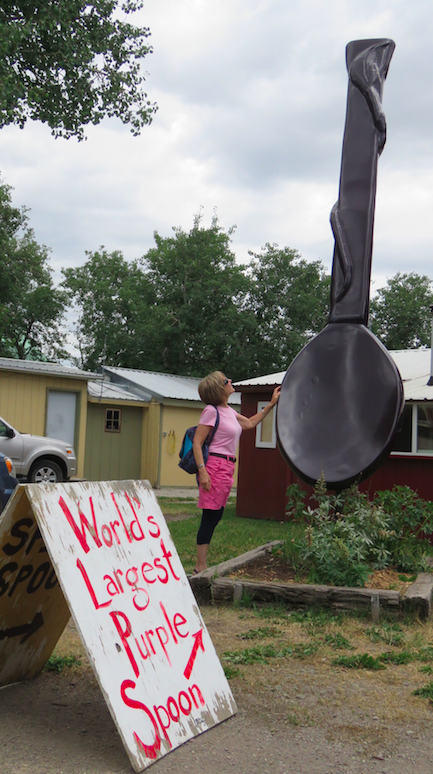
Treasures await by the World's tallest purple spoon

Jo Wagner and a few of her spoons.
If you're into wooden spoons, then head to East Glacier, Montana where you'll find The Spiral Spoon. I bet the store has more hand-made wooden spoons per square foot than anywhere else in Montana. Maybe the USA. Maybe the World.

You’ll find the World’s Largest Purple Spoon out front. You’ll want to snap a selfie in front of this impressive 14-foot tall kitchen implement.

There are a lot of wooden spoons at the Spiral Spoon, all made with various woods with loving care by Jo and Charley Wagner with a few helpers. I have never seen more impressive spoons. Most sell for $10 to $50, but you can pay more. I bet there are 300 to 400 spoons on display in the store’s three small rooms.
Jo even makes left-handed spoons, something you don’t see every day.

She’s all about the feel of the spoons. She holds each one lovingly, rubbing it. “It’s calming,” she says. “My best customers are blind people.” She says they appreciate the texture.

If you visit, be sure to look up at the ceiling where there are spoons to view, but not to buy. Many were used in TV shows or movies. Charley’s favorite is a spoon from the TV show Bonanza.

Many of the store’s popular spoons have a name. There’s Linda, Doris and Jack to name three. They’re named for friends. The idea is when inventory is running low someone can just yell, “Six more Lindas” to the spoon maker on duty.

Jo and Charley live year round in East Glacier. Most tourists (and customers) arrive in the summer. So in the winter, when it’s too cold outside to do anything but shiver, they hole up inside and make spoons.

The shop is open every day. If the door is locked, a sign says to ring the bell, which plays a nice rendition of Home on the Range. Usually the first to arrive will be Buddy, a friendly black and white dog of small stature and uncertain breeding.

JO WAS AN ENGLISH TEACHER before she took up spoon-making. She never even gave a thought about making something — a spoon, for example. But then she made one and the rest is history. “I never thought I had any talent,” she said, which is pretty funny when you see her beautiful creations.

Besides making spoons, she makes wands. After Harry Potter became popular the local kids started “badgering me to make wands,” she said. After resisting for awhile she did.

Today they fly out nearly as fast as she can make them, each with a certificate explaining what makes it special.

Some have a copper core. Some have buffalo hair. One has wolf hair. She calls the wands “magic” — not because of what they do, but how much profit they generate. “You see that car out there?” she asks, pointing out the window to her Ford Explorer. “What I made from the wands in the first two years I could have used to pay cash for that.”

At age 69, Jo is a whirlwind — "doing" the showroom, talking the talk, smiling, laughing, having fun. She’s one heck of a sales person. I listened to her as she rang the register for one customer after another. She looks at each person's name and then tells a story. “I’ve had several Elizabeth Taylors in here,” she says. “Jimmy Hendrix was in last week.” I asked her if the name was spelled the same. It wasn't.

After leaving the Spiral Spoon, be sure to go next door to Brownie’s Hostel and Bakery and get a Huckleberry milkshake.

You'll find the Spiral Spoon on the Web at TheSpiralSpoon.com.

Not a smooth ride with this wooden wheel bike


Back at the turn of the 20th century, bicycles were the rage. Cycling had become an important means of transportation, and in the United States an increasingly popular form of recreation. 

Bicycling clubs for men and women spread across the U.S. and Europe.

This bicycle from the early 1900s made by the Davis Sewing Machine Company of Dayton, Ohio, could not have been much fun to ride. With wooden wheels, no shock absorbers and only a thin layer of solid rubber covering the wheel, it must have been a jolting experience to take for a spin.

Lucky for us, our automotive tires today don’t ride on wooden wheels and solid rubber. Pneumatic tires changed everything. We can thank the bicycle industry for inventing them. By the time cars came along, the tires were already in production and improving.

Interestingly, the first pneumatic tire was developed in 1887 by John Dunlap for his son's tricycle. Commercial production began in late 1890 in Belfast, Ireland. Dunlop partnered with William Du Cros to form a company that would later become the Dunlop Rubber Company. 

I found this bicycle at the Marias Museum of History and Art in Havre, Montana.

Monday, July 20, 2015

Talking 27-foot penguin has lost its voice

The giant penguin of Cut Bank, Montana has lost its voice. For years, the roadside icon greeted visitors with "Welcome to Cut Bank, the coldest spot in the nation."

But no more. "It's been gone for years, said Dixie, a Cut Bank native and grocery checker at Albertson's where I stocked up with provisions in preparation for my journey east into the never never land of the far north of the Lower 48.

The statue by artist Ron Gustafson was erected in 1989. Until a few years ago it talked at the push of a button. Look it up in directories of roadside America and there it is, usually billed as the Giant Talking Penguin (or something like that).

Yet even without its voice, at 27 feet tall and weighing in at 10,000 pounds (of concrete), the massive bird lookalike is impressive. I'm thinking this must be the world's largest penguin.

You can't miss it when you're passing through Cut Bank on U.S. 2. It's right on the east edge of town by the Glacier Gateway Inn.

Ron GustafsonT


The sculpture, by Ron Gustafson, is in a style and made of material that might make it appear to be a classic -- 70 or 80 years old. But it was built more recently, in 1989. And it has a hidden feature -- when working -- it talks! - See more at: http://www.roadsideamerica.com/story/14586#sthash.G0S8w4AN.dpuf
The sculpture, by Ron Gustafson, is in a style and made of material that might make it appear to be a classic -- 70 or 80 years old. But it was built more recently, in 1989. And it has a hidden feature -- when working -- it talks! - See more at: http://www.roadsideamerica.com/story/14586#sthash.G0S8w4AN.dpu


The sculpture, by Ron Gustafson, is in a style and made of material that might make it appear to be a classic -- 70 or 80 years old. But it was built more recently, in 1989. And it has a hidden feature -- when working -- it talks! - See more at: http://www.roadsideamerica.com/story/14586#sthash.G0S8w4AN.dpuf

The sculpture, by Ron Gustafson, is in a style and made of material that might make it appear to be a classic -- 70 or 80 years old. But it was built more recently, in 1989. And it has a hidden feature -- when working -- it talks! - See more at: http://www.roadsideamerica.com/story/14586#sthash.G0S8w4AN.dpuf


Sunday, July 19, 2015

Sleep in a diesel locomotive

There are many places where you can sleep in a caboose. But to my knowledge there's only one place where you can stay in a locomotive — at the Issac Walton Inn on the southern edge of Glacier National Park.

From the outside, the Great Northern Railroad locomotive looks pretty much as it did when it was rolling on the rails. It's the two large picture windows on the north side that hint something is different.

It's been converted into a luxurious accommodation. For between $329 and $379 a night (lower rate in winter season) it can be yours. It's in big demand so make your reservation at least six months in advance.

The GN441 locomotive has been immaculately renovated into a plush lodging suite with luxury furnishings and fixtures unsurpassed by any other lodging options in the Glacier Park area. The living room features a stone fireplace. The bedroom has a king-size bed complete with a Hudson Bay blanket.

The kitchen is as fancy as in an upscale home or million dollar RV.

YOU CAN ALSO RENT CABOOSES of various sizes as well as traditional hotel rooms. The Issac Walton Inn with its rustic Swiss-style design is a gorgeous place, right along the tracks, which adds to the charm as well as attracts railroad buffs. Amtrak stops twice a day.

The inn, a National Historic Landmark along U.S. 2, was originally built to house workers building the railroad. Today, it's the hub of many outdoor activities. In the winter, cross country skiers converge to explore the 22 miles of local trails.

To learn more about staying in the locomotive or in the other accommodations call (844) 845-3629.
The layout of the locomotive. Click the image to view it larger.


Same scene, different camera lens. What a difference!

I took these two photos from the exact same spot along U.S. 2 west of Browning, Montana on the Blackfeet Reservation. The top one was shot with a very wide angle lens. The one below it was taken with a long telephoto lens. Look at the difference! What this illustrates is how easily you can alter the appearance of a photo with your choice of camera lenses.


Mom and Pop radio station operates from front porch of Montana famhouse

Along Montana Route 35, near Kalispell, there's a lonely yellow farmhouse with a few giant cottonwood trees out front. If you look closely as you pass, you'll see a small neon sign in the window that reads "On Air!"

This is the radio home of Montana Radio Cafe, 101.FM, a 100-watt radio station operated by Scott and Marie Johnston from the front porch of their farmhouse of 29 years. The radio tower out front is 100 feet high, the maximum the FCC allows for a low-powered station. The signal reaches nearby Kalispell, Columbia Falls and the west entrance to Glacier National Park. But that's about it. As radio stations go, this one's tiny.

Montana Radio Cafe is billed as "Front Porch Music Served Fresh Daily." Scott, with help from Marie, is the only staff.

Scott started KXZI-FM 11 years ago after working as a DJ at local Kalispell stations. He was frustrated by the short playlists —the same songs played over and over. He was bored, but it was a paycheck. After he began putting his tiny station together, he got fired from his job — "competition," Scott figured, although he couldn't fathom why anyone would be threatened by such a small-time operation.

THE FIRST NIGHT ON THE AIR he and his engineer drove to Kalispell and then other places, searching for the station on the car radio. Hearing it, said Scott, "was like a miracle."

There were no sponsors the first week. Scott wondered what the heck he was doing. How would he make money? Then, the second week, $800 showed up. "Hey, this can really work," he thought. And it has, although today it's not enough to support him and Marie all by itself. Scott figures it cost him about $16,000 to get the station up and running. Nowadays there is almost no overhead beyond a few hundred dollars a year in music licensing fees.

The station is a labor of love for Scott, 64, who has accumulated a playlist of 30,000 tunes — blues, folk, country, bluegrass, jazz — and lots of "miscellaneous" material too hard to categorize. Young and old tune in. "We span the generations," he says. Many of the artists are local, but there are big-time names, too. The programming is a hodgepodge. It's eclectic. It's one man's love of music shared over the airways.


Early on Scott set up templates to automate what was playing with some sense of order. One time, after a computer crash, the programming got screwy. Christmas songs were playing in the summer. Some people thought Scott was doing it on purpose, that there was some brilliant reasoning behind it. There wasn't.

Montana Radio Cafe is streamed on the Web at kxzi.com, expanding the audience well beyond the nearby small towns and farms. People listen from all over North America and around the world. Some make donations. A couple from Germany show up on occasion with a gift of homemade plum liqueur. Scott doesn't know how many people listen to his station, or where they listen — on the air or the Internet. He doesn't care. "I like being low key," he says. "I like being a creator more than an everyday business guy."

Musicians and bands stop by occasionally to perform. Sometimes Scott remembers to record what they play, and it ends up on his ever-expanding playlist. But other times he forgets. He plays guitar himself — he supported himself early in his career by performing — and he airs some of his own work. Few people know it's him.

THE STATION IS MOSTLY MUSIC. Scott breaks in during the day to thank sponsors, a few dozen who basically pay his bills and help the station earn a modest profit. Most messages are prerecorded. They're not ads like you hear on commercial radio but more like Scott just saying why he likes a place and then thanking it for its support.

Scott and Marie supplement the station's income by renting out a cottage in the back yard. Scott has sold cars out by the busy highway for a commission. He once sold a Porsche in 45 minutes. In a couple of years he'll have Social Security. Through the years he and Marie have raised six children, who have spawned 14 grandchildren.

Running the radio station is not a high-power, high-stress job. Each day, after getting his morning coffee, Scott heads to his front porch studio where he putters. The studio and a corner of the basement is his space. The rest is Marie's domain. That's fine with him. He has his music.

Honk your horn if you should pass by the station (those are Scott's orders). For now, just listen in by clicking here.


Friday, July 17, 2015

A toilet you won't find in today's homes (or RVs)

This is where you would have spent your toilet time before flush toilets became popular.

You probably would have had an outhouse, too. But this chair would certainly do the job without you heading outdoors first. You’ll notice the pot below, which would be removed for dumping and cleaning.

Scotsman Alexander Cumming patented the S-trap toilet in 1775, which laid the foundation for the modern flush toilet. But it was only until the turn of the 20th century with growing levels of urbanization and industrial prosperity that the flush toilet became widely used. In America, the chain-pull indoor toilet was introduced in the homes of the wealthy and in hotels soon after its invention in England in the 1880s.

If you travel to England today, you will often see a sign that says WC, which stands for “water closet.” The term "water closet" originated there indicating an interior or exterior room with a flushing toilet in contrast to an earth closet usually outdoors and requiring periodic emptying.

I found this toilet/chair in the Miracle of America Museum in Polson, Montana. Watch my three-minute tour of the wonderful museum.